Project
All projectsMeasuring Tremor with Consumer Devices
A scientific publication on whether smartphones and wearables can measure tremor accurately enough for clinical research in Parkinson's disease and essential tremor.
A scientific project in digital health
In 2020, I co-authored a scientific article on a practical digital-health question: can consumer devices such as smartphones and smartwatches measure tremor accurately enough for clinical research?
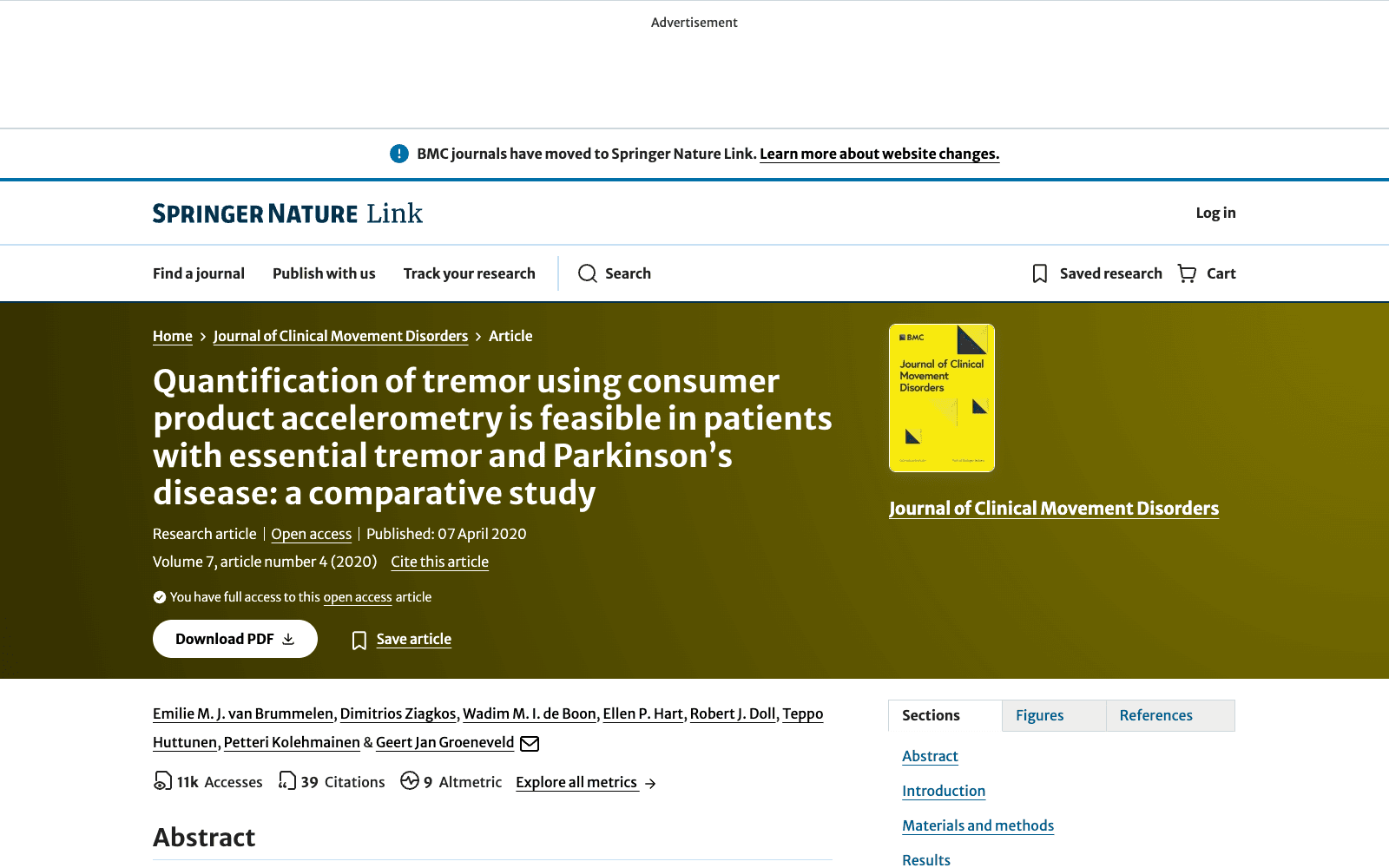
The paper, “Quantification of tremor using consumer product accelerometry is feasible in patients with essential tremor and Parkinson’s disease: a comparative study,” looked at tremor measurement in people with Parkinson’s disease (PD) and essential tremor (ET). The study compared consumer-device accelerometers with a laboratory-grade accelerometer used as the reference.
The aim was simple but important. Tremor is a key symptom in both conditions, and reliable measurement matters when assessing severity, treatment response and pharmacological effects. Traditionally, this kind of measurement has relied on research equipment. The study asked whether everyday devices could produce comparable results and make tremor assessment more accessible.
What the study showed
The study tested seven consumer devices: iPhone 7, iPod Touch 5, Apple Watch 2, Huawei Nexus 6P, Huawei Watch, mbientlab MetaWear watch and mbientlab MetaWear clip. These were compared with a laboratory-grade accelerometer in ten patients with PD and ten patients with ET. Tremor was measured in two positions: resting arm and extended arm.
The results were encouraging, especially for tremor frequency. In both PD and ET patients, peak tremor frequency measured by the consumer devices did not significantly differ from the laboratory-grade accelerometer within the limits of agreement. In plain English: the devices captured the key frequency signal reliably.
Amplitude was more complex. For ET patients, only the iPhone and MetaWear watch performed comparably to the laboratory reference. In PD patients, most devices performed comparably, except the iPod Touch and Huawei Nexus 6P. The study also showed that placement matters: devices placed farther from the body, such as clips and some handheld devices, tended to show higher amplitude than watches worn closer to the arm. That means amplitude data cannot always be compared directly across device types or locations.
Another useful result was that within-subject variability was lower than between-subject variability for both frequency and amplitude, and the resting arm position produced more stable measurements than the extended arm position. That matters for study design. Consumer devices may be especially useful in intra-individual or cross-over studies, particularly when measurements are taken at rest.
The conclusion was clear but appropriately bounded: consumer products can be used for tremography, and they may support at-home tremor measurements in clinical research. The interesting part is not only the technical result. It is the possibility of making measurement easier without losing scientific value.
Why this project matters to me
My background has included clinical-trial work since 2015, including GCP-related project management, ePRO activities and recruiting support. I have also spent years reading scientific articles and working through study details. I care about what a study says, but also how it was designed and what its limits are.
This publication brought those interests together. It sat directly between technology, science and pharmaceutical understanding. It also reflected the kind of work I find most engaging: projects where operational execution, scientific rigour and practical use all matter.
The bigger question is still relevant: how can widely available tools collect useful, trustworthy data in ways that are easier for patients and more efficient for researchers?
Consumer technology is easy to get excited about. The harder, more useful work is evaluating it properly, comparing it against a trusted reference and understanding where it works and where it does not. That balance between innovation and rigour is what makes digital health interesting.
If you are interested in clinical research, digital health or the practical use of technology in science and pharmaceuticals, you can get in touch using the form below.